
Evolutionary Perspectives on ADHD
What Psychiatrists Really Think


ADHD and Evolution: What Psychiatrists Really Think
ADHD is everywhere right now. It’s in clinics, classrooms, and public debate in addition to being one of the most talked-about conditions in psychiatry, and for good reason. Diagnoses are rising, services are stretched, and stigma still lingers.
On this Substack, we’ve touched on ADHD before: from Anne-Laure Le Cunff’s intriguing Hypercuriosity Theory, which frames distractibility as an evolutionary trait gone awry in modern contexts, to our very first clinical case series, which began with a problem-based learning case on ADHD. Each time, the response has been lively which proving that this is a topic that resonates widely.


But while the conversations around ADHD continue, one question hasn’t received much attention: how do psychiatrists themselves view evolutionary explanations of ADHD? Do these frameworks make sense to clinicians on the ground? Do they see value in evolutionary perspectives on ADHD? Could these ideas influence how they work with patients and families?
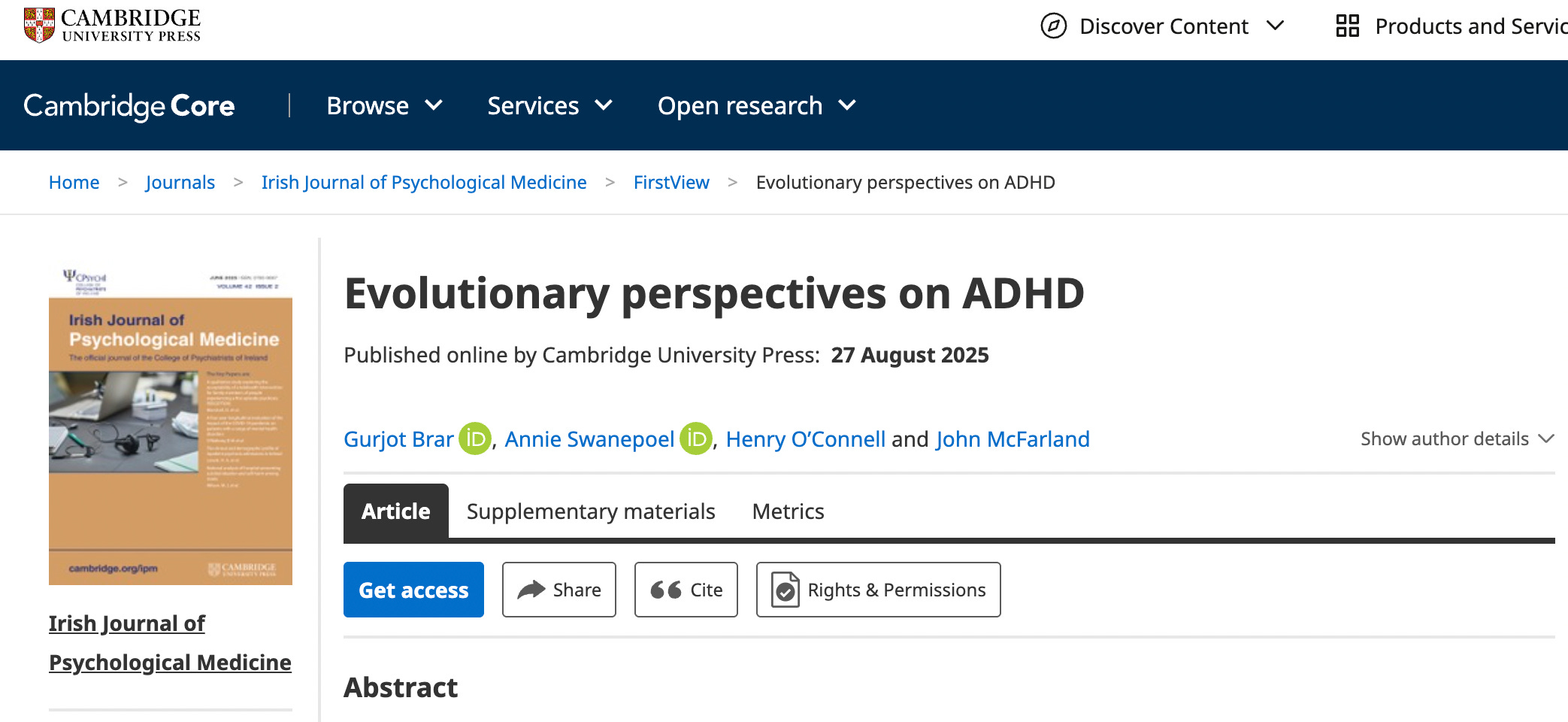
That’s the gap our recent study set out to address. Published this summer in the Irish Journal of Psychological Medicine, our research surveyed 40 psychiatrists working in Ireland following a presentation on ADHD through an evolutionary lens, delivered by our resident expert Dr. Annie Swanepoel (you might remember we covered her excellent 2023 talk here on the Substack and is also reposted below).

The findings offer a fascinating snapshot of how evolutionary psychiatry is received within the profession and why it might matter for the future of ADHD care.
📖 Read the full study here: Evolutionary perspectives on ADHD – Irish Journal of Psychological Medicine
The Study
We presented an overview of evolutionary perspectives on ADHD at the College of Psychiatrists of Ireland Winter Conference 2023 and then asked attendees to complete a bespoke 10-item questionnaire. In total, 42 participants responded:
21 consultants
19 trainees
2 medical students
We wanted to know: Did they find the ideas understandable? Useful? Likely to change their practice?
What We Found
High comprehension, high engagement
Every single participant rated their understanding as “high” or “very high.” Despite being a new perspective for many, it was seen as clear and accessible.
Strong support for clinical relevance
The responses were strikingly positive:
100% agreed the information could be useful for patients.
98% agreed it was useful for psychiatrists themselves.
62% strongly agreed they felt more optimistic about helping people with ADHD live well after the session.
Stigma and openness
Evolutionary framing seemed to have potential for reducing stigma:
84% agreed families would be more open to discussing ADHD if they heard this perspective.
83% believed that if these ideas were more widely known, people would be more likely to seek help.
Shifts in clinical thinking
Half of the psychiatrists said the session had changed how they think about ADHD (nearly a third strongly agreed). Most also said they would consider relaying evolutionary explanations to patients, and almost all believed this would have a positive impact.
Beyond ADHD
The interest didn’t stop there, 85% wanted to see evolutionary perspectives applied to other mental health conditions as well.
A Subtle Divide
Not all psychiatrists responded in the same way. Trainees and early-career doctors were consistently more enthusiastic about the practical value of evolutionary psychiatry. Senior consultants with over 10 years’ experience were more cautious, less likely to say the ideas boosted optimism or changed their clinical perspective.
This generational split could reflect simple openness to new frameworks among younger clinicians — or the cautious pragmatism of experience among their senior colleagues. Either way, it highlights the importance of building a stronger evidence base to bridge the gap.
The Words Behind the Numbers
The qualitative feedback was equally telling. Comments described the session as “interesting,” “useful,” and “thought-provoking.” One psychiatrist wrote that it made them reflect on their clinical practice; others expressed a desire to see similar talks in the future.
The overall message was the psychiatrists saw real promise in evolutionary psychiatry, particularly for reducing stigma and reshaping how ADHD is understood.
Why This Matters
ADHD remains heavily stigmatized, despite its prevalence and clear biological underpinnings. Too often, patients and families feel blamed or pathologized. By additionally framing ADHD traits as once-adaptive strategies that are mismatched with modern environments, evolutionary psychiatry offers a new complimentary narrative — one that is less about deficit and more about context.
Our study is just the first step. It’s small, exploratory, and more research is needed. But the overwhelmingly positive response suggests psychiatrists are open to and have an appetite for novel frameworks that help them connect with patients and families in more compassionate and effective ways.
Looking Ahead
If psychiatry is to move forward, it needs both rigorous science and broader explanatory models that make sense to patients, families, and society at large. Evolutionary psychiatry, with its focus on adaptation, mismatch, and ultimate causes, has the potential to provide exactly that.
For ADHD, the shift could be profound: from viewing traits as disordered flaws, to seeing them as echoes of survival strategies that no longer fit our current environment. In that reframing lies the potential to reduce stigma, improve engagement, and the prospect to reshape therapeutic outcomes.
📖 Read the full study here: Evolutionary perspectives on ADHD – Irish Journal of Psychological Medicine
If you enjoyed this article and would like to discover more about Evolutionary Psychiatry please consider:
subscribing to our Substack to receive regular content updates
visiting the webpage of the Evolution and Psychiatry Special Interest Group within the College of Psychiatrists of Ireland
visiting the webpage of the Evolutionary Psychiatry Special Interest Group within the Royal College of Psychiatrists
exploring a Youtube playlist on curated presentations by the Evolution and Psychiatry Special Interest Group within the College of Psychiatrists of Ireland
exploring the Youtube page of the Evolutionary Psychiatry Special Interest Group within the Royal College of Psychiatrists
exploring the Evolving Psychiatry podcast