
Evolutionary Mismatch and Modern Motherhood
Elena Bridgers on alloparenting, postpartum mental health, and what research on hunter-gatherers reveals (and much more)



I had the distinct pleasure to speak to Elena Bridgers who kindly answered several questions for this month’s article. I hope you all enjoy reading this interview.
Many of our readers will already be familar with you and your work but please let’s begin by you introducing yourself for those who don’t know you!
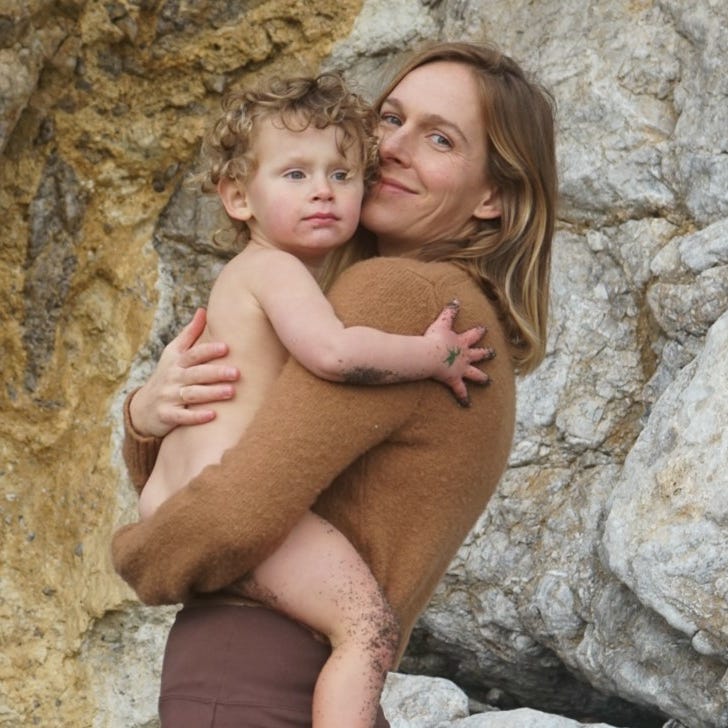
My name is Elena Bridgers. I am a science writer and researcher with a focus on maternal health and well-being. My work is deeply rooted in the concept of evolutionary mismatch - a theory that examines how contemporary lifestyles diverge from those our ancestors evolved to thrive in. I write a best-selling Substack newsletter, Motherhood Until Yesterday, and I am working on a book for Penguin Random House. I have published in peer-reviewed journals and my work has been featured in Newsweek, Today.com, and other major media outlets. I currently live with my husband and two young children in the southwest of France, but return often to the US (my home country).
Fantastic! Elena, my partner and I just had a baby 9 months ago and we absolutely love your Substack.
Almost daily, we find ourselves discussing the same central themes you often bring up (from alloparenting, co-sleeping, breastfeeding, parenting styles and more), and wish these types of conversations were more widespread.
Needless to say, we are big fans and we prepared a few questions for you, some deep, some personal and some fun ones too. We’re honoured you agreed to come on!
Thank you!! It’s an honor to be interviewed here. I really enjoy your newsletter as well.
Great let’s get started! Your work sits at a really fascinating crossroads: you take concepts from evolutionary biology and apply them to the everyday realities of motherhood, mental health, and modern culture. Some of your most popular articles are: Why I’m Not A Fan of Gentle Parenting, What the Best Research on Daycare Really Says, How to Actually Increase the Birth Rate. To start things off could you tell us a little of what drew you into that space in the first place? Was there a personal experience, a piece of research, or a moment of friction in your own life that made you think: this is where evolution and lived experience meet, and it needs to be written about?
It started after my second child, my daughter, was born, less than two years after my son. Caring for two children under two was a crazy experience, and I had very little support. My husband got zero paternity leave and my family lives far away. My son was attending a local daycare, but he was constantly home with some kind of viral illness. He was insanely jealous of my daughter. I felt constantly pulled in two directions by my two children who constantly needed me, often at the same time. I was wracked with anxiety over the fact that no matter how hard I tried I could not give them both what they needed, and of course, I could not meet my own needs either.

Somewhere in the chaos of that first year of my daughter’s life was when I started asking questions. I wanted to know: has motherhood always been this way? I was curious not just about the way things were before industrialization, but before capitalism, and even before agriculture. I have a background in evolutionary biology (I studied human biology at Stanford), but motherhood wasn’t a central theme in my coursework. I really did not know anything about the social context in which humans had evolved to mother until I started doing my own research.
Among the many books that I purchased was one called The Evolution of Childhood by Melvin Konner. I think I probably bought it because I knew Konner had been a mentor to Sapolsky, who I had worked with at Stanford and greatly admired, but when the book arrived, I remember thinking: there is no way I am actually going to read this thing. It was 960 pages long. The first chapter had subheadings like “heterochrony in the phylogeny of development,” and “phyletic reorganization in brain evolution.”
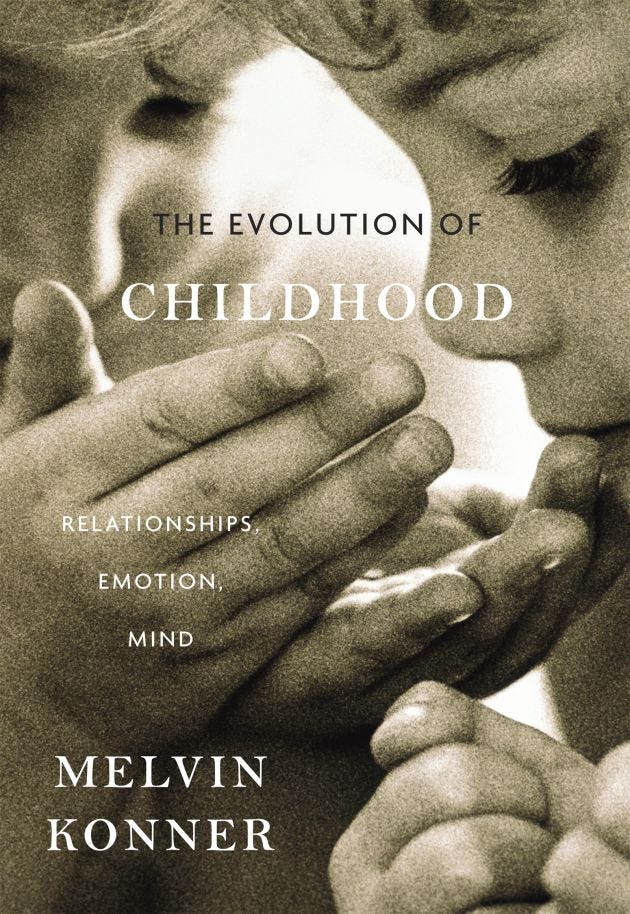
But I did manage to get through it, and as it turns out, that book had all the answers I was looking for. It changed my life, and started me down a very long trail of deep research that eventually turned into what is now a very exciting career researching and writing about motherhood and evolutionary mismatch.
Wow 960 pages! So was this the “aha” moment that redirected your focus into maternal health/evolutionary mismatch?
Yes it was Konner’s book that really kicked it off, but by now I have read literally hundreds of books, peer-reviewed papers, and ethnographies on these topics. I am still actively discovering new and exciting things, and this research is ongoing! There are some amazing anthropologists doing work with the Aka in the Congo and the Agta in the Philippines. Just last year a fascinating paper came out on children’s physical activity levels in hunter-gatherer societies, compared with ours. Unsurprisingly, they get loads of exercise, way more than our kids—and this has all kinds of interesting implications.
But from the beginning, some of the things I have consistently found to be most interesting are the long interbirth intervals in hunter-gatherer societies, the amount of alloparental help and support that mothers had, and the compatibility of foraging work with breastfeeding and babywearing. Those are themes that come up again and again in my writing and that have consistently struck a chord with audiences.

Over time, how has your worldview (especially around motherhood and mental health) evolved (mind the pun) — has anything you once believed changed?
Yes, absolutely. At the risk of sounding a bit corny or new-agey, I feel like studying hunter-gatherer societies has been a kind of awakening for me. It has totally changed my paradigm, not just the way I think about motherhood, but about the way I think about all of Western society, and about what I value. We are very individualistic in our culture, and I don’t think it’s healthy. We pathologize any kind of interdependence, but humans are a social and interdependent species. Hunter-gatherer societies are incredibly care-oriented relative to Western society, where we tend to view care as a burden. Studying these societies has helped me lean into motherhood more, lean into my relationships more, and let go (at least a little bit) of the achievement/productivity focus that drove most of my young adult life. I’ve also changed my mind on a lot of policy issues!
We are very individualistic in our culture, and I don’t think it’s healthy. We pathologize any kind of interdependence, but humans are a social and interdependent species.
It sounds like you come from a science/writing background; what difficulties or tensions have you encountered when bridging evolution and narrative writing?
It’s not easy parsing dense scientific literature (I spend a lot of time reading primary research papers) and making that come to life for an audience that does not necessarily have a science background, but that’s the whole fun of it! The hardest part is staying true to the research, and including all of the necessary nuance, without being overly boring or pedantic. Sometimes I oversimplify things, out of necessity, but I try really hard to be as accurate as possible.
What are the biggest pitfalls or misuses of evolutionary arguments in the domain of motherhood or mental health that you see in public discourse?
Oof! So many! In fact, the entire structure of my book is based on myth-busting (each chapter will bust a commonly-held myth about modern motherhood) which just goes to show you how much silliness is circulating out there. For example, the chapter I am working on right now is aimed at busting the myth that a mother’s natural place is in the home. 95% of mammalian mothers forage for themselves and their offspring with virtually no help from anyone, and although humans are an exception to this in that we have always relied on help from the community, the father-provider/mother-dependent framework is basically nonexistent in hunter-gatherer societies. Truly, mothers have always been breadwinners, the difference is just that it used to be fully compatible with breastfeeding and childcare.
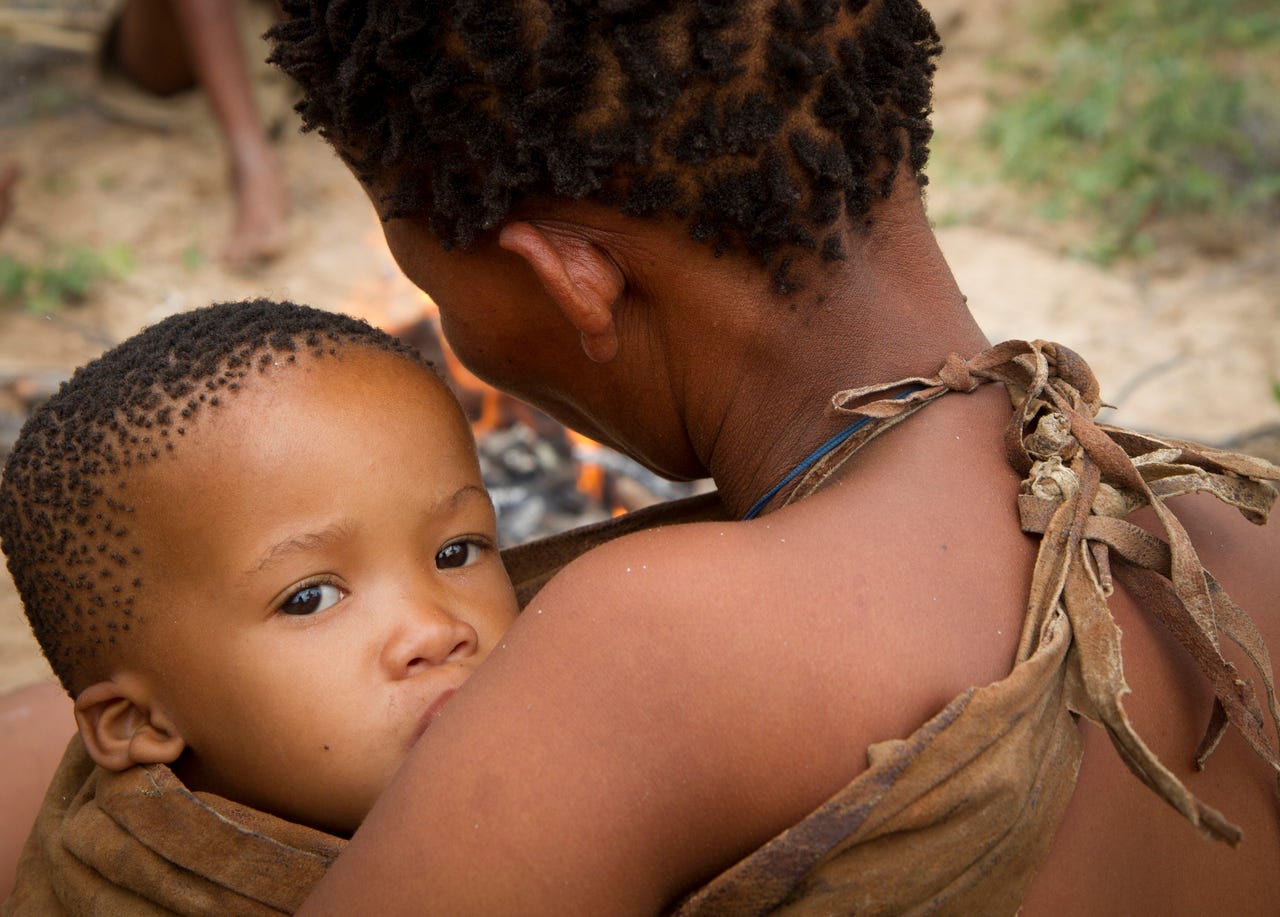
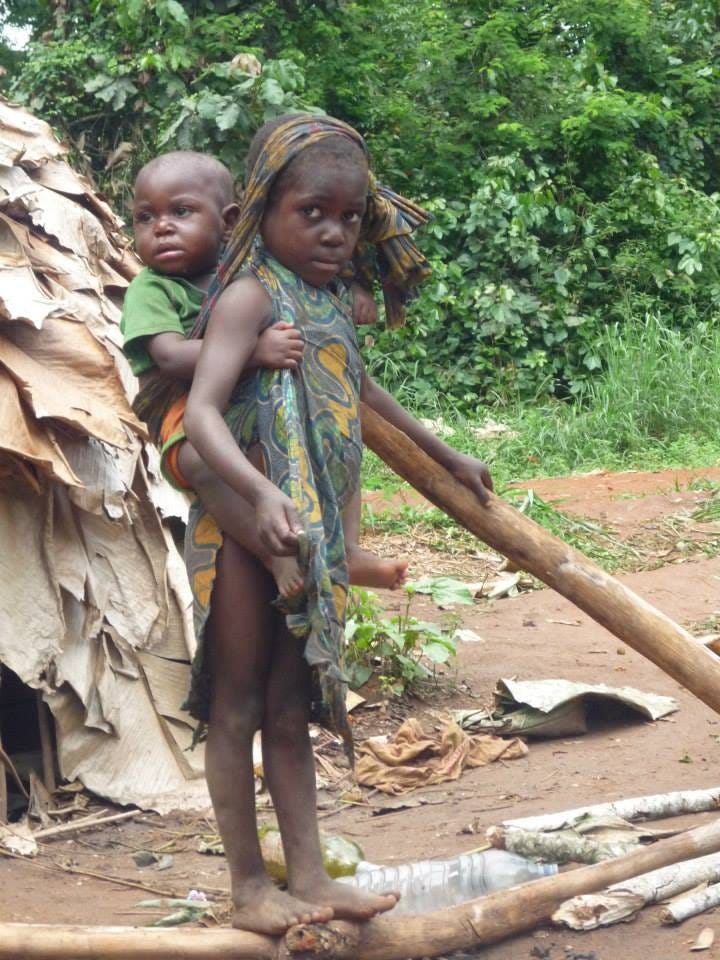
The other big myth I see gaining steam on social media these days (propagated by the likes of Erica Komisar) is that babies need constant maternal care, and that any non-maternal caregiving or mother-baby separation is harmful. This is just silly. Children–even very small infants–receive care from a huge variety of allo-parents in hunter-gatherer societies. Aka mothers provide as little as 25% of childcare in the first year of a baby’s life, and this may well have been the case for much of humanity’s evolutionary history. Of course, there are important differences between modern daycare and “allocare” in hunter-gatherer societies, and that’s another topic worth its own newsletter, but the idea that children need to be constantly cared for by their mothers because it’s “natural” is a myth.
Mothers provide as little as 25% of childcare in the first year of a baby’s life, and this may well have been the case for much of humanity’s evolutionary history.
You’ve written about “Separation Anxiety Is a Million-Year-Old Problem.” How do you see separation anxiety manifesting differently in modern contexts?
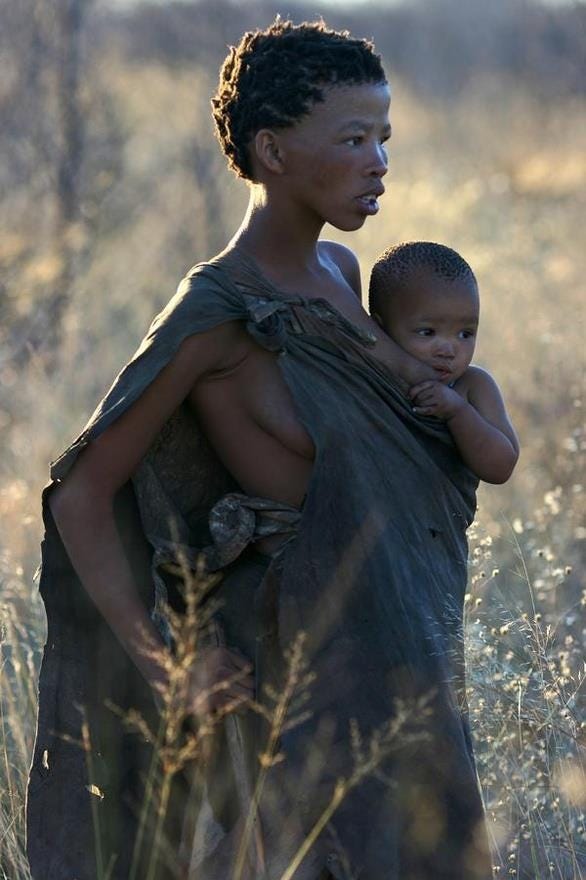
In most hunter-gatherer societies, mothers will leave weaned children in the care of older children while they go out to forage. Foraging is generally compatible with childcare and breastfeeding but it does slow mothers down, so once the constraint of breastfeeding is dropped (usually around age 3), mothers prefer to leave their three-year-olds behind in multi-age playgroups (kind of like Paleolithic preschool), but the three-year-olds are not happy about it! My feeling is that, in the modern context, we are confusing children’s temporary anxiety at being separated from their mother with long-term trauma. This is not to say that I am necessarily in favor of leaving very small babies in daycare centers for long hours (I’m not), but there is nothing out of the ordinary, from an evolutionary perspective, about a three-year-old who cries a little bit at preschool dropoff.
In your view, which aspects of modern parenting do you consider the most severe mismatches with what humans evolved to expect?
That’s a tough one. Evolutionary mismatch touches so many facets of our lives, but my research focus is really on motherhood. For contemporary Western mothers, having multiple, closely-spaced children with little community support is a huge area of mismatch: this was just not a challenge our ancestors had to deal with. But even with one baby, the isolating nature of motherhood is a struggle. In general, living in single-family homes is a very recent invention, but the absurdity of it really shows up in motherhood because so many mothers feel tied to the home when their kids are small, and this can be extremely isolating. Many Western mothers, myself included, feel simultaneously overstimulated, overworked, AND bored, which is really the result of the way we have set up motherhood in the modern context. For most of evolutionary history, having a baby did not mean you were suddenly isolated and segregated from society. Your work did not change, your social life did not change, your community did not change, your activities did not change–you just continued doing all of these things with a baby on your back. If you needed help with an older child while you breastfed your baby, there were 20 other adults in camp who could lend a hand. That’s a pretty stark difference from the modern maternal experience in America or Europe.
If you needed help with an older child while you breastfed your baby, there were 20 other adults in camp who could lend a hand. That’s a pretty stark difference from the modern maternal experience in America or Europe.
In evolutionary psychiatry, the thinking is that many traits or vulnerabilities persist because they conferred trade-offs or were contextually adaptive. What maternal emotional challenges (postpartum mood changes, anxiety, etc.) might you, hypothesize or is there any good evidence for, are trade-offs rather than “malfunctions”?
There is limited research available on this topic, but I strongly suspect that some level of postpartum anxiety was and is adaptive. Postpartum depression, on the other hand, may be a “disease of modernity,” meaning it’s the result of evolutionary mismatch, and probably did not exist in the hunter-gatherer context.
As long as it’s not crippling, postpartum anxiety is actually adaptive, because it motivates mothers to be extra vigilant and attuned to the needs of their babies. But postpartum depression doesn’t seem to have any real adaptive value. I struggle to imagine how it would have been adaptive in the hunter-gatherer context, and it certainly isn’t now. There’s a great research paper by Jennifer Hahn-Holbrook of UC Merced on this suggesting that PPD is the result of a combination of mothers being undersupported in the postpartum period, combined with breastfeeding mismatches, dietary mismatches, sunlight exposure and exercise mismatches. I think it’s credible!
In my own peer-reviewed paper, I suggest that it’s the result of close interbirth intervals, lack of community support, and lack of training (girls in hunter-gatherer societies get lots of practice with babies before becoming mothers, which increases self-efficacy). I’d also add that sleep is probably a major component and area of mismatch. Mothers in hunter-gatherer societies are not as sleep-deprived, because they sleep in close proximity to their babies and are able to feed them without waking up. In contemporary society, we discourage mothers from bedsharing due to SIDS risk, but it makes getting a good night sleep very hard, which can contribute to depression.
What might a modern “allomothering” infrastructure (formal or informal) look like, in your ideal design?
That’s a great question and also a really tough one to answer. It’s simply not possible to replicate the social structures of our evolutionary past in the modern context, but one thing I’d love to see more of is community living arrangements for families, where people have their own living spaces for their nuclear family, but arranged around a set of shared common spaces where it’s safe for children to play, with an open-door policy that encourages visits between homes. I’d also love to see on-site childcare become a real thing, so that mothers can work and be near babies (and even continue to breastfeed without pumping). I think the increasing number of work-from-home jobs is a positive trend for parents, and I think we could take it a step further by guaranteeing it as an option, especially for breastfeeding mothers, across most professions, and then subsidizing in-home help from a relative or a local babysitter to help mothers juggle work and childcare. Really, there is so much more we could be doing if we really cared.

How do you think parents can balance evolved inclinations (e.g. protective, anxious) with cultural pressure to “optimize” parenting?
My feeling is that a lot of these inclinations are very culturally-informed. For instance, I don’t know a single Western parent that would be totally chill letting their four-year-old climb up a swinging vine into the forest canopy, or play with a machete, but if you watch Caterpillar Moon, for instance, a documentary on Aka forest life, you’ll see that parents in that culture are totally okay with this stuff. They believe children need to take risks to learn. On the other hand, putting a baby in a crib by itself to sleep would make hunter-gatherer mothers extremely anxious, and yet we do this routinely in the West. What is paradoxical about Western parenting is that we spend less time in physical proximity with our children, and less time in intimate physical contact (especially with babies and young children), but we also center children much more when we are with them. I don’t think this is good for parents or children, and we should maybe take a leaf out of the hunter-gatherer playbook.
Elena, you highlight how hunter-gatherer mothers rely on broad allomaternal networks, while postindustrial societies outsource childcare to institutions like daycare. Do you see institutional childcare as an effective evolutionary substitute for allomothering — or does the lack of kin-based, emotionally invested support create qualitatively different outcomes for mothers and infants?
“Lonely, stressed-out moms: Does the postindustrial social experience put women at risk for perinatal mood disorders?” (2024, Evolution, Medicine, and Public Health)
Isn’t this the million-dollar question? Mothers have always relied on support networks of both related and unrelated caregivers to help with childcare, but the quality of this care is what matters. A baby in a large institutional daycare where a few caregivers are responsible for a large number of babies is not getting the care that he or she evolved to expect, or that he or she would have been given in the hunter-gatherer context. That said, children do not require exclusive maternal care to grow up healthy and happy, even in the first years. I’ve written extensively on this topic on my Substack, if you’re interested in diving deep on what the research really has to say, both in the hunter-gatherer and contemporary context.

Elena, you also note that in many small-scale societies, young girls gain childcare experience before their own first birth, which seems to buffer against perinatal mood disorders. In postindustrial societies, this “apprenticeship” is largely absent. Do you think reintroducing structured opportunities for adolescents to engage with childcare could serve as a modern intervention to reduce PMADs? I know you recently wrote about how boys have very limited opportunity in this regard leaving them relatively unprepared for fatherhood.
Yes. I think we need to reintroduce this into our education system, formally. We think parenting is instinctual (it’s not!) or that it’s a private concern, but if we started treating parenting as an essential learned skill that benefits all of society, then maybe we would be more serious about giving tweens and teens opportunities to practice (both boys and girls). This would have the added benefit of helping reduce the caregiving burden for mothers or childcare workers. I could imagine, for instance, a middle school being paired with a preschool or a nursery, and letting the older kids help care for and play with the younger kids. Parents would probably oppose this, because we don’t trust anyone anymore, but I think it would be a net positive intervention, if designed well.

I could imagine, for instance, a middle school being paired with a preschool or a nursery, and letting the older kids help care for and play with the younger kids. Parents would probably oppose this, because we don’t trust anyone anymore, but I think it would be a net positive intervention, if designed well.
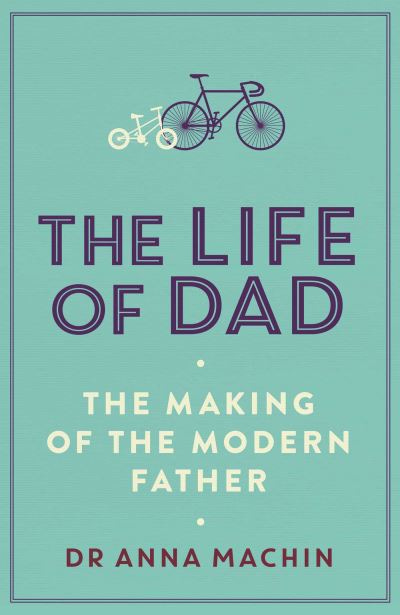
On that note, any comments on how the postpartum period affects fathers – I remember reading “Life of Dad – The making of the modern father” by Anna Machin, when I became a father for the first time in 2018 – I’m wondering if you’ve come across it? In it Machin discusses that becoming a father isn’t purely a social shift — the body, brain, hormones of men change, too. She’s also a proponent of the’ rough and tumble’ play and how father’s bond differently to their infants that mothers do.
I haven’t read it, but I loved Sarah Hrdy’s Father Time, which sounds similar, and I am glad to see this issue getting a lot more attention. Getting men more involved in caregiving has all kinds of knock-on benefits for society as a whole. Men who spend more time in intimate contact with young children are not only better caregivers (even years later) but they have higher levels of oxytocin and lower levels of testosterone, and societies in which fathers are more involved in childcare tend to be healthier and less violent. This is another topic I write about a lot in my newsletter and book.
What unanswered empirical questions (e.g. in data, longitudinal work) do you believe are most critical in understanding the intersection of evolution, motherhood, and mental health?
I would love to see more serious research on the intersection of birth spacing, support networks, and mental health in mothers. I would also love to have more robust research on things like bedsharing and babywearing: how do these practices (or absence of them) affect the mental well-being of mothers and children in the long and short-term? I’d also like to see more cross-cultural research on things like children’s daily routines, temperaments, and social environments and how these things interact. I’m deeply curious, for example, to understand how it’s possible that children in hunter-gatherer societies just fall asleep naturally after sundown (the ethnographers claim they do) while Western parents are all engaged in epic bedtime battles!
I’m deeply curious, for example, to understand how it’s possible that children in hunter-gatherer societies just fall asleep naturally after sundown (the ethnographers claim they do) while Western parents are all engaged in epic bedtime battles!
In your personal motherhood journey, how have your evolving perspectives (informed by your research) conflicted with lived experience or intuition?
I feel extremely lucky in that I have managed, mostly through sheer luck, to create for myself what I wish most mothers of young children could have: an extremely flexible, part-time work schedule that allows me to spend plenty of time with my children while also being engaged in work that feels meaningful and pays the bills. I do wish we lived closer to family, and I wish my kids’ school were more outdoors and play-based, but I think my biggest regret these days is that there are not more free-range kids hanging around our neighborhood that I can send my own kids off to play with! For me, the conflict was worst when my kids were really small, and before I’d made the switch to writing as a career, when balancing paid work with motherhood (at least, in the way that I wanted to be a mother) felt truly impossible. I felt pressured to sleep train, to return to work full-time before I was ready, to choose between having a social life and spending time with my babies, because we have made all of these things so incompatible in the modern context. Now I feel I’ve found more balance, but it’s been a long journey (and it helps that my kids are a bit older!).

What do you hope your readers or your forthcoming book will feel or do — what change or shift do you hope to provoke?
Mostly, I hope mothers will feel seen. I hope they will have the same kind of “aha” reaction that I had when I first read Konner’s book. I hope they will be able to let go of some internalized guilt or sense of failure when they realize how out of sync the modern motherhood experience is with our evolved physiology and psychology, and that this is something we have very little control over.
I will also have a chapter that addresses policy changes and community initiatives I would like to see more of. I’m hesitant to share those here because this stuff can be really controversial, and I think you need to read the book to understand all of the underlying logic and evidence behind what I am advocating for, but I do drop bits of it on my Substack from time to time.
What are you working on currently? And what’s in store for you in the near future?
Most of my time is spent working on my book right now. It probably won’t be out for another couple of years, but I love writing it! It’s always been my dream to be a writer, and I am just so grateful that I get to call this my job now. In the meantime, I publish at least once a week on my Substack, and cover many of the same topics that will be addressed in the book.
If someone would like to follow your work, where can they find you?
Here on Substack, my newsletter is called Motherhood Until Yesterday, or on Instagram @elena.bridgers
Bonus question! If you had to write a Substack post entirely without words — only images or charts — what would it be about?
Just tons of images of mothers and fathers and babies and children in hunter-gatherer societies! I love these images. My dream is to someday dig up all of the unused footage filmed on these societies and create a miniature documentary series to show people just how different parenting can be in a different cultural context!
Thank you again Elena for agreeing to do this and for answering so many of our questions! I think the work you’re doing is vital and I hope every one of our readers takes a look at your Substack and it inspires them to take a new perspective as you have done for us!
 | A guest post by
|
What struck me reading this wasn’t just the research… it was the clarity in naming what so many mothers already feel in their bodies long before they have language for it.
Modern motherhood asks one woman to do the work of an entire village, then pathologizes her when she breaks under the weight of an impossible structure.
Your exploration of mismatch exposes the truth many of us live: the mother is not failing. The environment is.
It’s important work. And it’s overdue.
Very cool interview and very interesting perspective on postpartum anxiety and depression! I was born in West Africa, and looking back, I can see how profoundly protective the community structure was for new mothers, compared to the US, for example. There was no expectation that a mother would care for a newborn alone. Community naturally “chipped in” (aunties who came to stay for weeks etc...). Mothers were surrounded, supported, and never isolated which is a massive protective factor against depression.